-
セミナー
2025.12.01
講師:田仲 由喜夫 教授(名古屋大学 大学院工学研究科)
日時:令和7年12月19日(金)13:30-
場所:大岡山西講義棟1 WL1-301 レクチャーシアターマヨラナ準粒子を始めとする非自明なエッジ状態を有するトポロジカル超伝導は様々な非従来型超伝導体において実現されることが明らかになってきた。このエッジ状態の起源は、ハミルトニアンの有するトポロジカル不変量に帰することが知られている[1-2]。
講演では、トポロジカル超伝導の持つ顕著な性質である1)常伝導金属との接合における零電圧コンダクタンスピーク[3]、2)ジョセフソン電流[3]、3)常伝導金属中の準粒子状態密度がゼロエネルギーでピークを持つ奇周波数電子対による異常近接効果[2,4-5]を紹介する。[1] Y. Tanaka, M. Sato, N. Nagaosa, J. Phys. Soc. Jpn. 81, 011013, 2012.
[2] 超伝導接合の物理 田仲由喜夫著 名古屋大学出版会 2021年
[3] Y. Tanaka and S. Kashiwaya, Phys. Rev. Lett., 74, 3451, 1995; Phys. Rev. B 56, 892, 1997.
[4] Y. Tanaka and S. Kashiwaya, Phys. Rev. B, 70, 012507, 2004.
[5] Y. Tanaka S. Tamura and J. Cayao, Prog. Theor. Exp. Phys., 08C105 2024.※「物理学特別講義(発展)第九」を履修する学生は本セミナーも聴講すること。
連絡教員 打田 正輝(内線2756)
https://www.phys.sci.isct.ac.jp/wp/wp-content/uploads/2025/12/430-henkou.pdf
-
セミナー
2025.11.30
講師:Professor Sho Takatori(Stanford University, USA)
日時:令和7年12月15日(月)14:00-
場所:南5号館5階 503CD室 大会議室Our lab uses quantitative microscopy and theory to develop constitutive and closure relations that bridge the particle-to-continuum field scales. In this seminar, I describe our application of feedback control on self-propelled agents to create spatiotemporal patterns and user-specified population distributions. We demonstrate the use of “gray-box models” that incorporate partially-known dynamics and learn the difficult-to-model terms (e.g., many-body interactions). We use the concepts of observability and time-delay embedding to model, forecast, and control the complex behaviors of active matter using continuum density data alone. By forcing the system to sample rare configurations, we can develop new constitutive field relations with appropriate closures. This project is aimed at deepening our understanding of mode coupling in nonlinear dynamics across the length and time scales.
連絡教員:物理学系 西口 大貴(内線2447)
https://www.phys.sci.isct.ac.jp/wp/wp-content/uploads/2025/12/117tokubetsu.pdf
-
セミナー
2025.11.27
講師:廣井 卓思 准教授(早稲田大学 先進理工学部)
日時:令和7年12月8日(月)14:00-
場所:南5号館5階 503CD室 大会議室ソフトマテリアルのナノ粒子(ミセルやベシクル)は、近年ドラッグデリバリーや生体親和性材料およびバイオ診断といった応用に向けて盛んに研究されている。これらの粒子は溶液中でのみナノスケールの構造体として存在し、その機能を発現するため、真空下の電子顕微鏡測定などではなく溶液中において粒径を決定することが重要である。この目的のために最も広く用いられている動的光散乱法では、溶液試料にレーザー光を照射し、その散乱光の強度のゆらぎを計測する。市販の動的光散乱装置では数nm~数百nmの粒径分布の推定が可能であるが、市販装置には以下のような問題点がある。
①白濁している試料を測定することができない。
②ホコリなどの汚染物質の影響を強く受ける。
③牛乳や生細胞など多くの化学種が含まれる対象について、化学種ごとの粒径分布を識別できない。
これらの問題を克服するために、当研究室では新たな動的光散乱装置の開発を行ない、これまで困難であった白濁した系や汚染物質を含む系、および多成分系溶液中での粒径分布計測に成功した。本講演では、動的光散乱法の測定原理を説明した上で、当研究室で開発した様々な動的光散乱装置および今後の研究展望について紹介する。
連絡教員:物理学系 西口 大貴(内線2447)
https://www.phys.sci.isct.ac.jp/wp/wp-content/uploads/2025/11/429.pdf
-
セミナー
2025.11.17
講師:Kim Young-Min氏(韓国天文研究院 (KASI))
日時:令和7年11月28日(金)15:30-
場所:本館地下 B61 物理学系輪講室The neutron star binary GW170817 detected via gravitational waves and the neutron star observed by NICER provide astronomical constraints on the equation of state (EoS) of dense matter. More precise and diverse astronomical observations are expected to further strengthen constraints on the EoS of dense matter. This presentation will focus on gravitational-wave observations and comprehensively discuss related topics. It will also include a brief introduction to research utilising next-generation gravitational-wave detectors.
連絡教員:物理学系 関澤 一之(内線2463)
https://www.phys.sci.isct.ac.jp/wp/wp-content/uploads/2025/11/428.pdf
-
お知らせセミナー
2025.10.30
日時:令和7年11月25日(火)13:30-14:30(第1部)15:00-16:00(第2部)
場所:東京科学大学 大岡山キャンパス 本館1階 M-123 講義室(ネット配信なし)
講師:Professor Seth Lloyd (Massachusetts Institute of Technology)・量子情報、量子コンピューティングの理論で世界的に著名なMITのSeth Lloyd教授の講演会です。
・Lloyd教授の話は大変分かりやすいことで有名ですので、学生さんを含めどなたもご参加ください。事前登録不要、英語です。
・前半(第1部)は量子コンピューティングについての全般的なイントロ、第2部は最新の研究成果についてです。
https://www.phys.sci.isct.ac.jp/wp/wp-content/uploads/2025/10/Seminar_-Seth-Lloyd.pdf
-
セミナー
2025.10.25
講師:下村 顕士 氏(京都大学 基礎物理学研究所)
日時:令和7年11月18日(火)14:00-
場所:本館地下 B61 物理学系輪講室For open quantum systems obeying a Lindblad equation, it is a challenging problem to clarify and classify what kind of non-equilibrium steady state (NESS) the system relaxes to after a sufficiently long time. In this talk, we consider open quantum spin systems on infinite lattices described by the Lindblad equation and present a definition of the NESS in such infinite systems. The NESS in infinite systems is not necessarily equivalent to the thermodynamic limit of the NESS in finite systems; the former may correspond in finite systems to a metastable state, not a NESS. We see this in a solvable model. We also find a sufficient condition for equivalence of them, which relates to both the Liouvillian gap and nonnormality, i.e., nonorthogonality among eigenmodes of the Liouvillian. The enhancement of nonnormality can cause spontaneous symmetry breaking (SSB) for the NESS in infinite systems, which we dub nonnormality-induced SSB. Since a Liouvillian is normal in unitary dynamics, such a type of SSB is unique to open quantum systems. Furthermore, the nonnormality-induced SSB can occur even when the Liouvillian is gapped. This work uncovers a novel phase of matter in open quantum systems and establishes a way to classify it by focusing on nonnormality. This talk is based on the preprint arXiv:2508.07448.
連絡教員:物理学系 山本 和樹(内線2724)
https://www.phys.sci.isct.ac.jp/wp/wp-content/uploads/2025/11/427.pdf
-
セミナー
2025.10.25
講師:松田 智裕 教授(埼玉工業大学 工学部)
日時:令和7年11月17日(月)13:30-
場所:本館2階 290 物理学系輪講室This seminar will discuss applications of exact WKB analysis in physics and explore how it can differ from conventional calculations. After explaining the Landau–Zener transition, on which our analysis is based, we will expand the model to see how the difference manifests itself in the calculation. In the first part [1], we provide specific examples where the linear approximation at the level crossing, commonly used in Landau-Zener transitions, does not yield a good approximation. We will also mention the possibility that the Stokes lines may differ depending on whether the interacting electric field is a classical electromagnetic field or a photon[1]. As applied examples, we also explain particle creation in the early universe[2], the emergence of asymmetry due to CP violation[3], the Schwinger effect[4], the Unruh effect[4], and Hawking radiation[4]. For CP violation to affect the asymmetry between particles and antiparticles in baryon number generation, it is shown that multiple Stokes phenomena must undergo quantum interference[3]. Particle production in steady states, such as the Schwinger effect and Hawking radiation, can be solved “locally” by examining in detail how degrees of freedom like gauge and Lorentz symmetries are treated in differential geometry[4].
[1] Phys. Rev. A 112 (2025) 3, 032224, e-Print:2505.09240
[2] JHEP 03 (2021) 090, e-Print: 2010. 14835
[3] JHEP 02 (2022) 131, e-Print: 2104. 02312, JHEP 01 (2023) 088, e-Print: 2203.04497
[4] JHEP 05 (2025) 216, e-Print: 2404.19160, Int. J. Mod. Phys. A 40 (2025) 28, 2550130, e-Print:2501, 09919連絡教員:物理学系 藤井 啓資(内線2136)
https://www.phys.sci.isct.ac.jp/wp/wp-content/uploads/2025/11/426.pdf
-
セミナー
2025.10.24
講師:橋本 佑介 特任准教授 (東北大学 学際科学フロンティア研究所)
日時:令和7年11月10日(月)16:30-
場所:本館2階 290 物理学系輪講室
AI やロボットアームなどに代表される先端技術の急速な発展による影響は多くの分野へと波及しつつあり、材料科学にも新たな視点と研究開発手法をもたらしている。私はこれまでに、材料特性の実験データと計算データを機械学習によって統合し、物性と構造の類似度を同時に反映する材料マップを開発してきた[1]。さらに、ロボットアーム、電動ピペット、3Dプリンタを用いた自動実験システムを構築し、金属有機構造体(MOF)などのナノ材料合成の自動化を推進している。これらの自動実験を通じて得られる再現性の高い信頼性のある材料データベースは、今後のデータ駆動型材料開発の基盤となる。加えて、生成AIを活用したマルチエージェントシステムにより、自動かつ自律的なデータ分析手法の開発も進めている。本セミナーでは、これらの新技術を統合することで実現されつつある、材料研究開発の新しい枠組みについて紹介する。
References
[1] Y. Hashimoto, et al., APL Machine Learning 3, 036104 (2025)連絡教員:物理学系 佐藤 琢哉(内線2716)
https://www.phys.sci.isct.ac.jp/wp/wp-content/uploads/2025/10/425.pdf
-
お知らせ教員公募
2025.07.07
-
お知らせ
2025.07.01
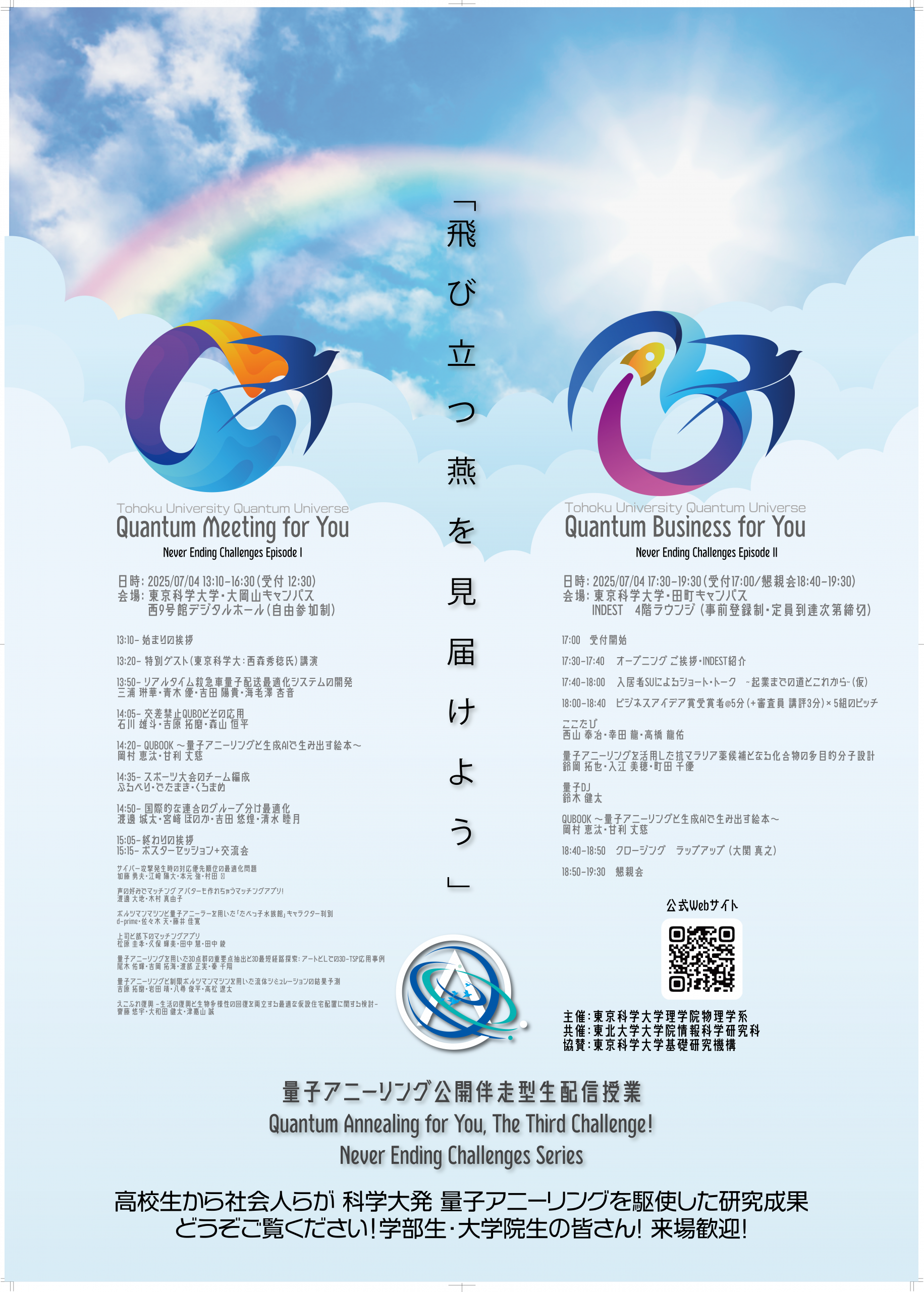
日時:令和7年7月4日(金)13:10~16:30(受付 12:30)
場所:西9号館 ディジタル多目的ホール
参加費:無料(申込不要でご参加いただけます)QA4U3 卒業優秀賞(アカデミア5組)が研究成果について講演する夢の1day!
本年1月より開催している公開伴走型生配信授業「QA4U3」の
卒業試験より優秀賞5組のピッチイベントを開催します。
QA4U発学術研究や論文になる優れた研究発表を聴くチャンスです!詳細は下記URLをご参照ください。
https://altema.is.tohoku.ac.jp/QA4U3/pg24.html※上記ページ内にある「Quantum Meeting for You, in Science Tokyo」のタブから詳細がご覧いただけます。